

In my previous blog, I investigated how easy it is to migrate a Power BI report (with the semantic model) to AI/BI dashboards. One comment stood out:
“Very cool. I’m curious how Genie can then be used to answer questions directly based on the semantic model or the visuals? Also, is there any ‘Narrative’ feature like Power BI has now to generate an executive summary? This would be super useful as to be honest nobody wants to interpret visuals anymore, we only care about getting our BI questions answered straight to the point.”
That comment resonated not because it’s universally true, but because it reflects a real frustration. Research shows that 41% of business leaders don’t understand their data because it’s too complex, and 70% of BI users stick to less than 10% of available features out of confusion. So then, is natural language the answer? Can Databricks Genie do it better? Can it get to the point faster? As someone who has worked as a data analyst, this raised a question I couldn’t shake.
Can I trust insights I didn’t earn?
The Analyst’s Dilemma
I earn my insights. I build the dashboard choosing the measures, setting the filters, validating the numbers against what I know to be true. By the time I present a visualization, I’ve traced every number back to its source. The insight isn’t just shown; it’s verified through the act of creation.
But Genie changes this. It generates the visualization. It writes the SQL. It gives me the answer in seconds. And I’m left wondering: is this right? Not because Genie is wrong but because I didn’t build it. I didn’t earn it.
Of course, research tells me I might be fooling myself. Studies show that manual work can breed overconfidence that the labor of building doesn’t guarantee accuracy, just the feeling of it. And users of automated systems fall into the opposite trap: trusting outputs without scrutiny. Both can be wrong. Both can be right.
Business users don’t share my hesitation. For them, natural language is liberation no more filters, no more dropdowns, no more waiting for the analyst. They ask, they understand, they act.
So here’s my conflict: the interface that builds my trust isn’t the interface that serves my users.
What Research Says About Trust
Research on human-AI collaboration offers a reframe. Studies on “complementary expertise” show that users calibrate their trust in AI for unfamiliar tasks based on how accurately it performs on tasks they can verify (Pareek et al., 2024).
This is exactly my situation. I know the dashboard. I built the measures, validated the logic, tested the edge cases. If I ask Genie the same questions and it gives me the same answers, I can extend that trust to questions I haven’t personally verified. My expertise becomes the calibration mechanism.
There are also two distinct types of trust at play. Verification trust the kind I build through dashboards comes from seeing the data, tracing the lineage, checking the math. Delegation trust the kind business users need comes from understanding the explanation and believing the reasoning (Datameer, 2022). One is earned through labor; the other through transparency.
Here’s the connection: I can’t personally verify every answer Genie gives to every user. But I can verify the foundation Genie draws from the semantic layer. When metric definitions are centralized, governed, and versioned, I verify the logic once. Genie inherits it every time. The dashboard and Genie draw from the same source of truth. My verification trust becomes the infrastructure for their delegation trust.
And the research supports this approach: semantic layers, centralized, governed definitions of business metrics, reduce LLM hallucinations by over 50% and push text-to-SQL accuracy toward 99.8% (Atlan, 2026). Which means, the foundation matters more than the interface.
The Hypothesis
So here’s my hypothesis: the dashboard doesn’t compete with Genie, it enables it.
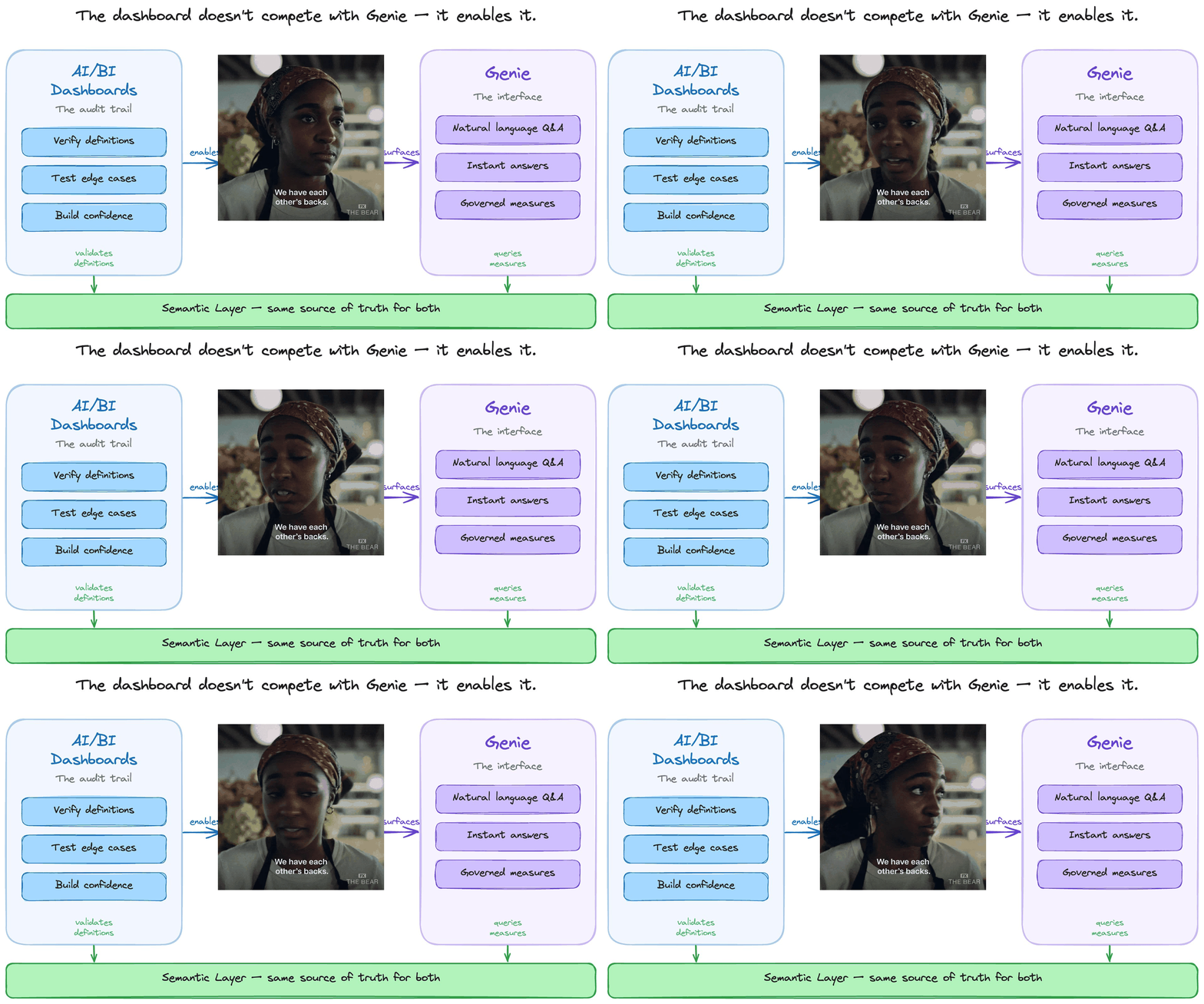
If I validate the semantic model through dashboard interaction, I create the trust infrastructure that allows business users to safely delegate to Genie. The dashboard becomes the audit trail where I verify definitions, test edge cases, and build my confidence. Genie becomes the interface where users ask questions in natural language and receive answers I’ve already validated.
The analyst earns the trust. The user inherits it.
What’s Next
In the next posts, I’ll test this hypothesis.
Migrating the interpretation from Power BI semantic model to Databricks Genie: Using Claude and the Power BI Semantic Model MCP, I’ll extract insights from a dashboard and migrate them to a Databricks Genie space deploying with BrickKit (library from Cauchy),
Lets get technical: Metric views is the key, translating DAX to Metric Views, and converting RLS to Unity Catalog row filters.
Testing: Same data. Same questions. Different interface. Does the trust transfer?